Hexa Words: Sort Associations
SeverexWord
4.4385.00 Reviews
- Version
- 1.9.1
- Installs
- 500.00K
- Age Rating
- Everyone
Screenshots
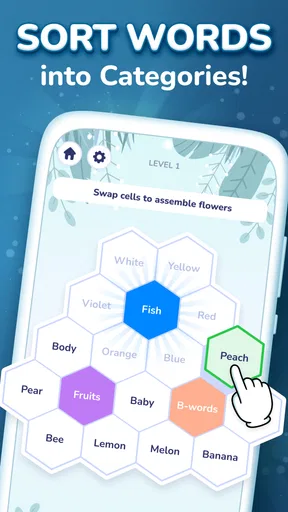
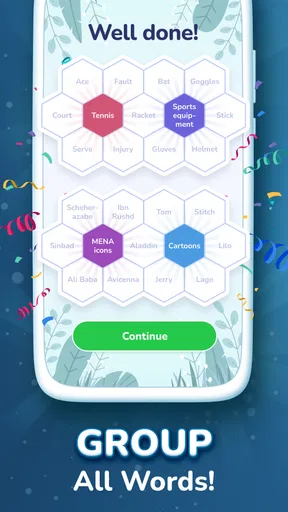
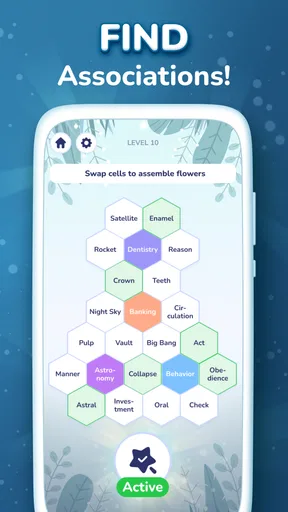
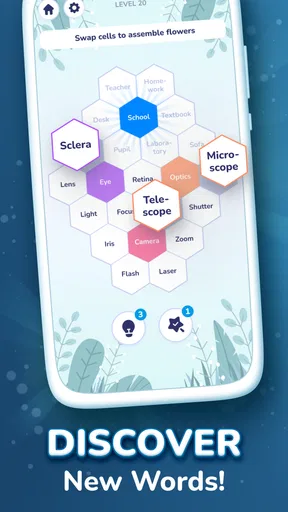
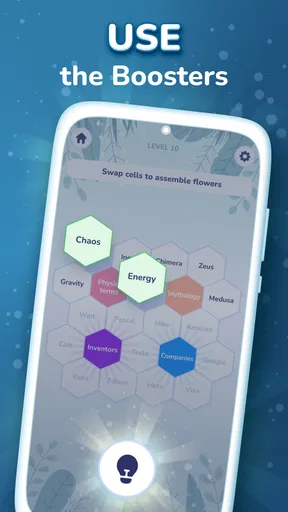
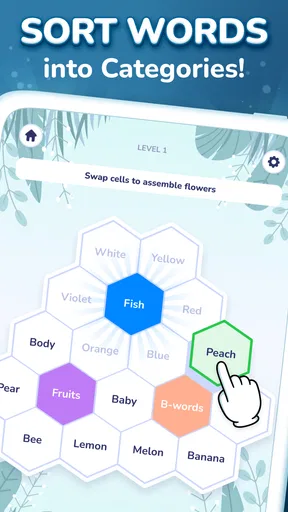
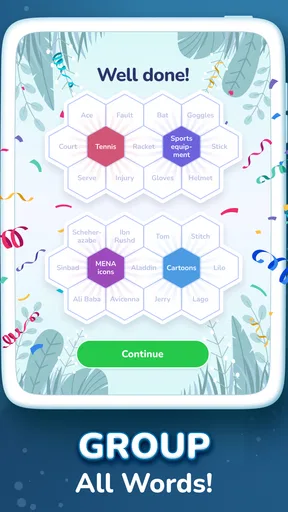
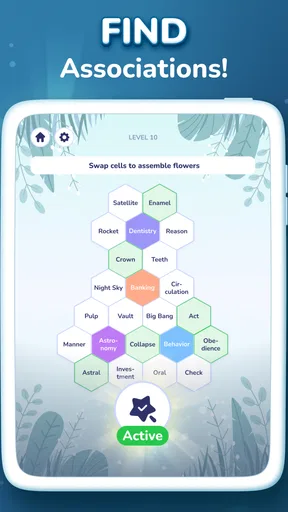
Our Review of Hexa Words: Sort Associations
 Analysis by Appyee
I found Hexa Words: Sort Associations most interesting when I stopped treating it like a quick word quiz and started using it as a small exercise in classification. The basic challenge is to connect words through categories and associations, but the real work is deciding which relationship matters most. A word may seem to fit several groups, and that uncertainty is where the game earns its place among casual brain-training titles.
It is a free word game from Severex, rated for Everyone, with a 4.4 average from around 3.2 thousand ratings. The audience is already fairly broad, and the game’s simple premise makes sense for short sessions on an Android device. It supports Android 8.0 and later, while the current version is 1.9.1. I would describe it as approachable rather than effortless: the controls are easy to understand, but some puzzles ask for careful reading instead of quick guessing.
How the association puzzles feel in everyday use
The first thing I noticed is that the game does not depend on fast typing or complicated controls. The central activity is sorting words into meaningful connections, so the challenge comes from interpretation. That makes it suitable for a quiet break, a commute, or a few minutes before bed. I can pick it up without needing to remember a story, manage a character, or learn a long chain of rules.
A realistic use case is a short waiting period when I want something more engaging than scrolling. I might begin with an obvious group, then use the remaining words to test whether my first assumption was correct. This creates a useful rhythm: identify a likely category, place the words, inspect what is left, and revise if the leftovers do not form a sensible set.
The most important habit is to solve by elimination, not only by recognition. A word that clearly belongs somewhere can still be the wrong choice if it prevents the other words from forming a stronger category. I found that holding back one apparently obvious answer often makes the whole board easier to understand.
Where new players are most likely to get stuck
The main friction is ambiguity. Everyday words can have several associations, and the game’s difficulty comes from choosing the intended connection rather than merely finding a possible one. If I rush, I tend to lock onto the first relationship I notice. That can make the remaining choices look impossible, even though the problem is really the original grouping.
When a board feels confusing, I recommend separating words into three mental piles: words with a strong shared meaning, words that might be linked by context, and words that currently seem unrelated. Start with the strongest pile, but do not commit the borderline words too early. This approach is more reliable than trying to force every tile into a group immediately.
Another useful check is grammatical or functional similarity. Sometimes a connection is not about the objects themselves, but about how the words are used. If several candidates seem connected only because they can follow the same phrase, compare that possibility with more direct categories before committing. The game rewards attention to the exact relationship, not just a loose theme.
I also found that frustration usually grows when I repeatedly make the same guess without changing my reasoning. If two attempts produce the same awkward leftovers, I treat that as evidence that the category is wrong. Clearing the mental slate and looking for a different type of association is more productive than defending the first idea.
What to check before blaming the game
Because this is a lightweight word puzzle, setup should be uncomplicated. The game is free to install, and its Everyone rating makes it suitable for a wide age range. If I were preparing it for another person, I would first check that the device runs Android 8.0 or newer and that the app has finished updating to version 1.9.1.
That simple check matters when a puzzle appears to behave strangely. An installation that has not completed properly, an outdated build, or a device running an older operating system can create problems that look like gameplay faults. I would close the app, reopen it, and confirm that the installation is complete before spending time troubleshooting individual puzzles.
I would also make sure the screen responds consistently. Association games depend on selecting the intended word accurately, so a missed tap can look like an incorrect answer. If one area of the screen repeatedly fails to register, I would test other apps or menus on the device. That quickly separates a touch-screen issue from a problem specific to this game.
For someone using the game on a shared device, I would begin with a short session rather than handing it over with no explanation. The rules are easy to demonstrate, but the difference between a direct category and a loose association is worth explaining. A player who understands that distinction will usually enjoy the puzzles more and make fewer random attempts.
A practical recovery routine when a puzzle stalls
When I reach a board that seems blocked, I use a repeatable recovery routine. First, I reread every word instead of focusing only on the two or three that caught my attention. Second, I identify the most restrictive word: the one that appears to have the fewest plausible connections. Third, I test possible groups around that word while leaving flexible words aside.
This works because flexible words are often the source of misleading combinations. They can fit several themes, while a more unusual word may reveal the intended direction. I do not need to solve the entire board in one burst. Finding one dependable relationship can reduce the number of possibilities enough for the rest to become clearer.
A second recovery method is to challenge the category itself. If I describe a suspected group using a vague phrase such as “things related to travel,” I ask whether I can make the description more precise. A strong group should have a clear reason for existing. If I cannot explain the connection in a short sentence, I probably have a temporary pattern rather than the intended answer.
I would avoid tapping through guesses just to see what happens. That may feel faster, but it teaches me less about the puzzle and can make a solvable board feel arbitrary. A better workflow is to pause after an incorrect grouping, note which word caused the conflict, and rebuild around the remaining set.
For younger players, this recovery process can become part of the value of the game. Instead of treating a mistake as failure, I would ask what changed after the words were rearranged. That turns the puzzle into a lesson in flexible thinking and helps prevent the habit of choosing the first answer that sounds plausible.
When the app may not be the cause of the problem
Not every poor session points to a technical issue. Word association depends heavily on language familiarity, cultural context, and personal vocabulary. A player may understand each individual word but still find the intended grouping unfamiliar. That is a limitation of the format rather than evidence that the game is malfunctioning.
Fatigue also matters more here than in a simple matching game. When I am distracted, I tend to accept weak connections and overlook obvious ones. If the same type of puzzle feels easy one day and irritating the next, I would take that as a reason to pause rather than immediately reinstall the app or assume the board is unfair.
Screen size and input accuracy can affect the experience as well. On a smaller phone, closely placed words may require more careful tapping, especially when I am trying to rearrange several options quickly. Slowing down is usually enough. If taps fail across the device, I would investigate the phone’s touch response; if only this game reacts oddly, restarting it is a sensible first step.
There is also a difference between a puzzle being difficult and a puzzle being unclear. Difficulty asks me to discover a connection I have not seen yet. Unclear design would make it hard to understand what action is expected. Since the game’s premise is straightforward, I found that most confusion came from the word relationships rather than from learning the interface. That distinction helps me decide whether to rethink the board or check the installation.
How it compares with familiar word-game alternatives
Compared with a crossword, this game asks less about spelling and more about grouping. I do not need to build answers from clues crossing one another. Compared with a word search, it offers less of the satisfaction of scanning a letter grid and more of the challenge of interpreting meaning. Compared with a traditional anagram game, the key skill is not rearranging letters but recognizing a shared idea.
That makes it a good choice for players who enjoy language but do not want a long-form puzzle that demands a notebook or a large uninterrupted session. It is also a better fit than a speed-focused word game for anyone who prefers reflection over rapid responses. On the other hand, people who want a clear score chase, a competitive timer, or a deep progression system may find this style too quiet.
The association format has a particular trade-off: it can feel more thoughtful than a basic matching game, but it can also feel more subjective. A crossword usually gives strong structural feedback through intersecting letters. Here, I have to judge whether a connection is intentional. Players who dislike ambiguity should know that this is central to the experience, not an occasional inconvenience.
Who should try it, and who should skip it
I would recommend it to casual puzzle players, families looking for an accessible word activity, and anyone who enjoys sorting ideas into neat groups. It also suits people who want a compact mental warm-up without committing to a lengthy campaign. The Everyone rating makes it an easy title to consider for mixed-age use, although individual vocabulary will still affect how comfortable each player feels.
I would be more cautious about recommending it to someone who wants a dictionary-style learning tool. The game encourages thinking about relationships between words, but that is not the same as offering systematic vocabulary instruction. Likewise, players looking for action, narrative, or elaborate visual progression should choose another kind of game rather than expecting this one to provide those elements.
The free entry point is helpful for trying the format without an upfront purchase. There are in-app purchases ranging from $0.99 to $11.99 per item, so I would treat optional spending as something to review before allowing a child to play on a shared device. The important question is not whether the game can be sampled for free, but whether the available play experience matches the player’s tolerance for optional purchases.
My final take after using the word-sorting format
Hexa Words: Sort Associations succeeds because its central idea is simple but not shallow. The words are easy to read, yet the intended relationships can require patience, comparison, and a willingness to abandon a tempting first answer. I especially like that a stalled puzzle can often be recovered through better reasoning rather than faster tapping.
Its limitations are tied to the same design choice. Ambiguous associations can feel subjective, and the experience will not satisfy players who need competition, story, or a strong sense of progression. It is also not the best option when I want structured vocabulary study. For those needs, a crossword, spelling trainer, or more competitive word title may be a better match.
Still, as a free word game from Severex, it offers a focused way to spend a few spare minutes. Its 500 thousand-plus installs show that the format has found a substantial audience, while the current 4.4 average suggests that many players respond well to the balance of simplicity and mental effort. I would install it for relaxed category puzzles, keep the recovery routine in mind, and judge each difficult board on the quality of its connection rather than on how quickly I solve it.
Verdict
Strengths of Hexa Words: Sort Associations
- Simple rules make it easy to start playing immediately.
- Short levels fit well into quick breaks or casual sessions.
- Word associations encourage flexible thinking and vocabulary recall.
- Clean visual design keeps the puzzle board easy to follow.
- Gradual challenge increase provides a satisfying sense of progress.
Limitations of Hexa Words: Sort Associations
- Some word connections may feel subjective or open to interpretation.
- Later puzzles can become repetitive if played for long sessions.
- Hints or assistance may be limited when a solution feels unclear.
- Players seeking action or variety may find the gameplay too calm.
- Difficulty can vary noticeably between consecutive puzzles.
Other Releases by Severex
View All
Trivia Spin-Guess Brain Quiz
Trivia4.4
Similar Picks in This Category
View All
Word Search - Word Puzzle Game
Bluetile4.8

Word Search Quest - Puzzles
Blackout Lab4.8

CodyCross: Crossword Puzzles
Fanatee, Inc.4.7

Words of Wonders: Crossword
Fugo Games4.9

Wordscapes: Word puzzle game
PeopleFun4.7

Word Search Explorer
PlaySimple Games4.9
Frequently Asked Questions
What is Hexa Words: Sort Associations?
Hexa Words: Sort Associations is a word puzzle game built around grouping related words into matching sets. Instead of simply finding anagrams or completing crossword clues, you examine a collection of words, identify their shared theme or association, and place them into the correct group. The game is designed for short, relaxing sessions while still requiring vocabulary, logic, and careful observation.
How do you play Hexa Words: Sort Associations?
Each level presents several words that must be organized according to their relationships. You need to read the available terms, recognize which ones belong together, and sort them into the appropriate hexagonal groups. Some connections are obvious, while others rely on word meanings, categories, expressions, or less direct associations. If you make a mistake, you can review the remaining words and try a different combination.
Is Hexa Words: Sort Associations free to download and play?
Hexa Words: Sort Associations can generally be downloaded for free, allowing players to access the core puzzle experience without paying upfront. However, free versions of mobile puzzle games may include advertising, optional purchases, or paid features such as hints, extra attempts, or ad removal. Before downloading, it is worth checking the current store listing for pricing, in-app purchase details, and any platform-specific restrictions.
Does Hexa Words: Sort Associations require an internet connection?
The main word-sorting puzzles may be playable without a constant internet connection, which makes the game convenient for travel, commuting, or playing when mobile data is unavailable. Nevertheless, certain functions—such as advertisements, synchronization, updates, leaderboards, or in-app purchases—may require connectivity. Availability can vary between Android and iOS versions, so offline access should be confirmed after installing the current release.
Is Hexa Words: Sort Associations suitable for all ages?
Hexa Words: Sort Associations is generally suitable for players who enjoy vocabulary and logic challenges, including older children, teenagers, and adults. The difficulty can increase as the levels progress, and some word categories may require broader general knowledge or familiarity with language. Parents should still review the store rating, advertising practices, and purchase settings, particularly if children will be playing on a shared device.
Play our best games!


